
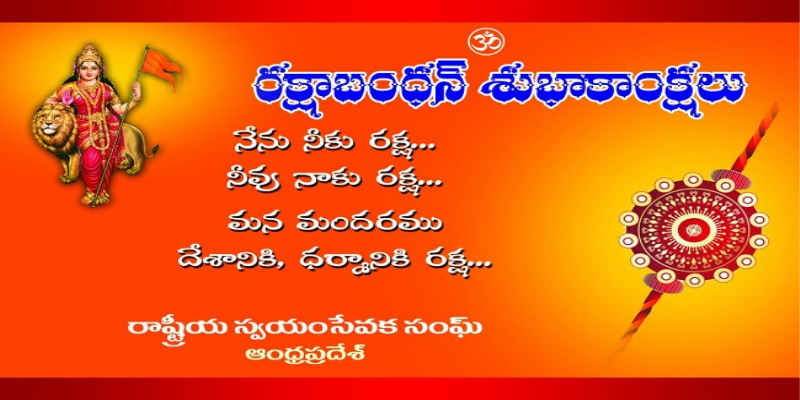
Raksha Bandhan—let’s take oath on swadeshi and suraksha
Pournima,(the full-moon day) that comes in the month of Sravan every year, is a festival that imparts lot of samskaras(good habits) to the whole Hindu society. On this auspicious occasion, we, the Hindus, tie Rakshas (sacred threads) each other to represent the symbolic brotherhood and take an oath for mutual protection.
The holy day has an inspiring message, “Taking the responsibility of mutual protection, that result in protection of whole mankind by Hindu society”. As said in vedas, “I protect you, you protect me, and in turn we together safeguard our dharma, society, nation, and culture”.
The Raksha has the immeasurable strength of binding a powerful demon (asura) and its strength would be perpetuated. The Sanskrit hymn “yena baddho baliraja , danavendro mahabalha, tenatwam abhibadnami rakshe Machala Machala” gives the same message to all.
Rashtrya Swayamsevaka sangh(RSS) celebrates the festival for the welfare of universal mankind. It hoists the Bhagava Jhanda (holy saffron flag) in lakhs of places across the world. The Raksha that is tied to Bhagava Jhanda in this celebration prepares the Hindu society for integration and consolidation. It remembers every Hindu the sacred responsibility of safeguarding of country, dharma, society, and culture of his own and invokes every Hindu to be ready for this noble cause.
Since 1926, Dr. keshav Baliram Hedgewar, the founder of RSS was successful in transforming the “dharmic (religious) ritual” into “a social event of celebration” for all to ensure Hindu consolidation.
The history of this festival tells us that it is evolved to protect women and Dharma. Over the last 1200 years, it has got its significance, in the wake of foreign and Non-Hindu invaders’ attacks on women and dharma. There were many instances wars among the rulers of different Rajyas used to send rakshas each other to avoid loss in both sides in the history. We, habitually, tie rakhsas to protect ourselves form evil forces. Dr. Hedgewar, developed it a habit among the Swayamsevaks that they tie rakshas to protect their motherland, culture and dharma. It has gained wide importance especially in the critical hour of nation.
Our enemies are fighting day-in and day-out in direct and indirect ways. They are trying every possible means- by hook or crook. Either in the name of religion or by forcing us to trade, and to use products manufactured in their country. They also try to weaken our labour force and economic activities by exploitation of our natural resources through devilish policies. The conspiracy of some countries mainly china and Pakistan are to be retorted with care and determination.
We should not allow interference of foreign countries in our day to day life and life style. We must not use the products manufactured by some aggressive countries against us. Chief priority is to be given to swadeshi (made in our country) products and we ought to develop self respect, self sufficiency, swadeshi thinking, practicing our own dharma, and protect our nation to the core.
The best practices of our Hindu society (samskaras) are highly capable of bring the world about the utmost glory of the world. One among the most important institutes to be safeguarded is our family system. It is a wider institute, envisaged by our great saints and sages, involves not only the blood-relations but also include the whole mankind ie. Vasudiva Kutumbakam . It is high time to take oath on protecting the family system un-affected by any malicious external forces.
We live in the habitat surrounded by nature which has been thoroughly affected exploitation for various modern selfish scientific researches. We should also take an oath to preserve our mother nature. We adore the nature by protecting the rivers, mountains, forests, trees and cows. Let us be determined to preserve and protect the elements that protect mankind by adopting swadeshi and suraksha.
This article as was translated to english by Shri. M.ESWARA RAO, Asst.Professor, Group of Languages and Humanities, BS & H Dept,GMR Institute of Technology ,Rajam-532127 Srikakulam -Dist., A.P. India.
Original article was written by Shri. K Laxman Rao in telugu.