“Ibrahim spoke in support of RSS when first ban was proposed in 1930s”: Sarsanghachalak Dr Mohan Bhagwat
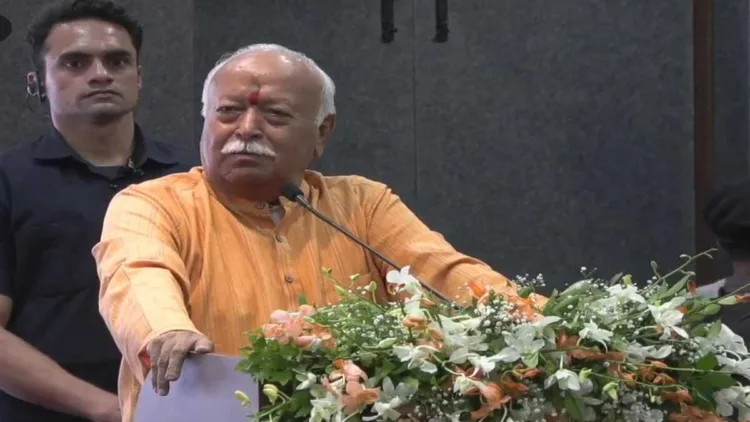
NAGPUR : RSS Sarsanghchalak Dr Mohan Bhagwat, while speaking in Nagpur, recalled an incident from the 1930s when an attempt was made to impose the first ban on the Sangh in the Central Provinces Assembly.
“In the Assembly of Central Province, there was no Swayamsevak to defend the Sangh; there was no one supporting the Sangh ideology either. There was one Mr Ibrahim who spoke in support of the Sangh, saying that it should not be shut down and that it was not communal.
While speaking, he said, ‘I know Dr Hedgewar; he is not mental; he is a good person. So, the Sangh cannot be communal.’
It had been a few years since the formation of the Sangh. It wasn’t well-known, but everyone knew Dr Hedgewar. When the Sangh began, Swayamsevak became its identity. Even today, after 100 years, Swayamsevak is the Sangh’s identity.” Bhagwat said Ibrahim argued that the RSS should not be shut down, citing founder Dr Keshav Baliram Hedgewar as a good person and rejecting allegations that the organisation was communal.
On the occasion, a book dedicated to the contribution of RSS Pracharaks was also launched. Speaking about a book documenting the lives of RSS pracharaks, Bhagwat said such accounts were being written out of gratitude and affection rather than for any material benefit. He said pracharaks neither expect nor seek personal gains, as their commitment was centred entirely on the organisation. He said, after experiencing various strands of freedom struggle, Dr Hedgewar started RSS as a man-making methodology.
“For a pracharak, there is only the Sangh. The Sangh is everything, and nothing else exists for him,” Dr Bhagwat said. He added that people who came into close contact with pracharaks developed a natural sense of reverence and respect for them because of their sacrifice and character. The RSS Sarsanghachalak said their devotion and dedication could not be adequately captured in writing, as these qualities were best understood through personal experience. Only those who had interacted directly with such individuals could fully appreciate their commitment, he said.
‘Swimming against the tide’
Describing the life of a swayamsevak as one of “swimming against the tide”, Bhagwat said it involved following principles without selfishness, ego or personal expectations. He said the central concern of a volunteer was how much good he could contribute to the society. He clarified that not every volunteer might fully embody these ideals and that individuals differed in their abilities, qualities and levels of commitment. However, he maintained that their overall direction remained the same, with dedication serving as the common thread. Drawing from his own experience as a pracharak, Bhagwat said he had observed this dedication among fellow pracharaks over the years.
Bhagwat was speaking after inaugurating a newly constructed auditorium at the renovated headquarters of Nagpur Nagrik Sahakari Bank Limited on November 9, 2026. While addressing the audience, he reflected on the Sangh journey over the past 100 years and the contribution of its swayamsevaks, to the organization and the nation.
Significance of the statement
The 1930 incident is not the first one when the Sangh was targeted by the Government machinery. In the case of the Rashtriya Swayamsevak Sangh (RSS), history has been frequently rewritten by those desperate to delegitimise its nationalist roots. Recent revelations by Sarsanghchalak Dr. Mohan Bhagwat regarding a 1930s legislative attempt to ban the Sangh serve as a stark reminder: the British Raj’s hostility toward the organisation was not born of a concern for communal harmony, but of a deep-seated fear of a resurgent, unified India.
In the Central Provinces Assembly, the colonial administration sought to stifle the burgeoning movement led by Dr. K.B. Hedgewar. Yet, the attempt failed, not because of a lack of effort by the British, but because even then, the Sangh’s nationalist character was recognised by diverse voices. As Dr. Bhagwat recalled, it was a Mr. Ibrahim who stood in the assembly to defend the organisation, explicitly stating that the RSS was not communal. This historical footnote shatters the modern-day narrative that seeks to paint the Sangh Swayamsevaks that did not participate in the freedom struggle. Towing the line of the Communist historians, Congress and Many Muslim leaders try to question the RSS role in India’s freedom Struggle. MIM leader Asaddddin Owaisi also toed the same line and repeatedly questioned and criticised the RSS’s contribution to India’s independence movement, and calling into question the historical role of early Sangh leaders like K.B. Hedgewar. If the Sangh was not fighting for the nation against the British Raj, as its detractor’s claim, why would the colonial state— an expert in divide-and-rule tactics —have invested so much energy in trying to dismantle it? Why the Government servants were bans from participating in the RSS activities? Why did the CID reports and intelligence surveillance on the RSS and Hindu nationalists run into thousands of pages? The narration of the 1930’s incident by RSS Sarsanghachalak Dr Mohan Bhagwat opened up these and many questions that debunk the false narrative on the Sangh and its contribution during the freedom struggle and the way nationalist leader saw the role of RSS as a unifying force beyond political spectrum.